Who Makes Mazda Cars? Ownership & History Guide


Mazda’s ownership story is one of the most misunderstood in the car industry. Ford owned part of it for decades. Toyota now holds a stake in it. It’s headquartered in Japan but builds cars in Alabama. And its name traces back to both an ancient deity and the company’s own founder.
Most people searching “who makes Mazda” want a straight answer, and then walk away more confused after reading vague articles that raise more questions than they answer. This guide gives you the complete, accurate picture: who makes Mazda, who owns it today, where every major model is assembled, and what the brand’s reliability record actually looks like.
Table of contents
- Who Makes Mazda Cars?
- The Origins of Mazda — From Cork to Cars
- Toyota, Ford, and Mazda Ownership
- Who Owns Mazda Today?
- Where Are Mazda Cars Made?
- Mazda’s Manufacturing in the USA — The Alabama Plant
- What Technology Does Mazda Build Its Cars With?
- Is Mazda a Reliable Car Brand?
- Final Thoughts
- FAQs
Who Makes Mazda Cars?
Mazda cars are made by Mazda Motor Corporation, an independent Japanese automaker headquartered in Fuchu, Aki District, Hiroshima Prefecture, Japan.
The company is publicly traded on the Tokyo Stock Exchange under ticker symbol 7261. No single foreign company controls it. Ford does not own it. Toyota does not own it. Mazda makes its own product, engineering, pricing, and brand decisions entirely independently.
Here are the fast facts:
| Full name | Mazda Motor Corporation |
| Founded | January 30, 1920 |
| Headquarters | Hiroshima, Japan |
| Employees | ~48,700 |
| Stock exchange | Tokyo Stock Exchange (7261) |
| Country of origin | Japan |
The Origins of Mazda — From Cork to Cars
Mazda’s story starts well before it made a single car. The company was founded on January 30, 1920 in Hiroshima, Japan, as Toyo Cork Kogyo Co., Ltd., a cork manufacturing business. Its founder, Jujiro Matsuda, transformed the company over the following decade from an industrial materials producer into a vehicle manufacturer.
The “Mazda” name has a dual origin that competitors rush past without explanation. It references Ahura Mazda, the Zoroastrian deity associated with wisdom, light, and harmony. It also carries a direct phonetic connection to founder Jujiro Matsuda’s own family name. The name was a deliberate choice, a bridge between ancient symbolism and the family identity behind the brand.
In 1927, the company changed its name to Toyo Kogyo Co., Ltd. Four years later, it built its first vehicle.
Key milestones in Mazda’s early history:
| Year | Milestone |
| 1920 | Founded as Toyo Cork Kogyo in Hiroshima |
| 1927 | Renamed Toyo Kogyo Co., Ltd. |
| 1931 | First vehicle — the Mazda-Go, a three-wheeled truck |
| 1960 | First passenger car — the Mazda R360 |
| 1967 | Launched the Cosmo Sport — first production rotary engine car |
| 1979 | Ford Motor Company deepens partnership |
| 1984 | Company officially renamed Mazda Motor Corporation |
| 2017 | Capital alliance formed with Toyota |
| 2022 | First US-assembled Mazda rolls off Alabama production line |
Toyota, Ford, and Mazda Ownership
Toyota, Ford, and Mazda ownership explained and clarified in simple terms.
Does Ford Own Mazda?
No. Ford does not own Mazda. The two companies have had no ownership connection since 2015.
But the Ford-Mazda relationship was real, substantial, and lasted over four decades, which is why the confusion persists. Here’s the full timeline:
| Year | Ford-Mazda Ownership Event |
| 1974 | Ford acquires an initial stake in Mazda |
| 1979 | Ford deepens the partnership; production sharing begins |
| 1996 | Ford increases stake to 33.4% — its peak ownership position |
| 2008 | Ford begins selling Mazda shares to raise capital during its financial restructuring |
| 2010 | Ford’s stake drops to approximately 3% |
| 2015 | Ford sells its remaining shares — ownership stake reaches zero |
At its peak, Ford’s 33.4% stake made it Mazda’s largest single shareholder, and the partnership produced tangible results for both companies. The Ford Probe and Mazda MX-6 shared the same platform. Both companies operated a joint assembly facility, AutoAlliance International, in Flat Rock, Michigan, producing the Ford Mustang and Mazda6 on the same line.
Ford sold its shares to raise cash during its post-2008 financial restructuring, not because Mazda was performing poorly, and not because the engineering partnership had failed. By 2015, every last share was sold and the operational relationship dissolved.
What Mazda kept from the Ford era: disciplined platform engineering, global supply chain experience, and a deeper understanding of North American market preferences. None of Ford’s current products share platforms or production with Mazda.
Does Toyota Own Mazda?
No. Toyota does not own Mazda. Toyota holds a 5.1% minority stake, a strategic position, not a controlling one.
Toyota acquired a 5% stake in Mazda in 2017, which eventually grew to 5.1%, while Mazda acquired a 0.25% stake in Toyota in return. Both sides framed this explicitly as an alliance between equals, not an acquisition.
The alliance covers four areas of collaboration:
- A joint manufacturing plant in the United States
- Joint development of electric vehicle technology
- Connected-car technology development
- Advanced safety system collaboration
When Toyota and Mazda first announced their alliance in August 2017, the companies cited the agreement as a milestone in the journey to further strengthen and accelerate the partnership in a sustainable way.
Toyota’s 5.1% stake gives it a board seat and a collaborative relationship, it does not give Toyota any authority over Mazda’s product decisions, brand direction, or engineering choices. Mazda designs, engineers, and sells its vehicles as an independent company. The Mazda you buy at a dealership is a Mazda, not a rebadged Toyota, not a Ford in disguise.
Who Owns Mazda Today?
Mazda Motor Corporation is a publicly traded company. Its shares are held by a mix of Japanese institutional investors, international funds, Toyota (5.1%), and individual shareholders.
Mazda is owned by the Mazda Motor Corporation, an independent Japanese automaker. It is not owned by Ford, Toyota, or any other car company.
That independence is rarer than it sounds. Most automakers of Mazda’s size have been absorbed by larger conglomerates. Volvo is owned by China’s Geely. Jaguar Land Rover is owned by India’s Tata Motors. Chrysler is part of Stellantis, a Dutch-registered multinational. Mazda remains one of the few mid-size automakers in the world that still operates as a genuinely self-directed company.
Mazda employs approximately 48,700 people globally and recorded annual revenues of 4.83 trillion yen in fiscal year 2024, its highest revenue figure on record at the time.
Where Are Mazda Cars Made?
Mazda’s primary manufacturing base is Japan, but the company operates production facilities across six countries to serve different global markets.
| Country | Plant | Models Produced |
| Japan — Hiroshima | Ujina Plant No. 1 & 2 | Mazda3, CX-5, CX-30, MX-5 Miata |
| Japan — Yamaguchi | Hofu Plant | Mazda6, CX-5, CX-9 |
| USA — Alabama | MTMUS, Huntsville | CX-50, CX-50 Hybrid |
| Mexico — Guanajuato | MMVO, Salamanca | Mazda2, Mazda3 |
| China — Nanjing | Changan Mazda | CX-5, CX-30 (China market) |
| Thailand — Rayong | AAT | CX-5, CX-30 (Southeast Asia) |
The Hiroshima plants remain the core of Mazda’s manufacturing identity. Most vehicles sold in North America and Europe originate from Japan or Mexico, depending on the model and trim level.
Where Is the Mazda CX-5 Made?

The Mazda CX-5 is primarily built in Japan. Since production began at Hiroshima’s Ujina Plant Number 2 in 2011, Mazda has expanded CX-5 manufacturing to Ujina Plant Number 1, Hofu Plant in Yamaguchi Prefecture, and facilities in China for domestic sales there.
For North American buyers, CX-5 units are primarily sourced from the Hiroshima plants. The CX-5 is not built in the Alabama facility, that plant produces only the CX-50 and CX-50 Hybrid.
Cumulative global production and sales of the Mazda CX-5 reached five million units by the end of 2025, making it one of only three Mazda models to cross that milestone. The CX-5 has been Mazda’s global best-selling model every year since 2018.
How to verify where your specific CX-5 was made: Check the first character of the VIN number. “J” as the opening character means the vehicle was assembled in Japan. “M” indicates Mexico. “3” indicates USA. You’ll find the VIN on the driver’s side dashboard, visible through the windshield. For a full breakdown of how to read a VIN number, see our guide on VIN numbers on a car.
Who Makes the Mazda 3?
The Mazda3 is produced at two primary locations depending on the market:
- Ujina Plant, Hiroshima, Japan — primary production site; supplies many global markets
- MMVO Salamanca Plant, Mexico — produces Mazda3 units primarily for North American buyers
US buyers may receive either a Japan-built or Mexico-built Mazda3 depending on the trim level and model year. Both plants follow the same production standards and specifications. The same VIN check applies: “J” for Japan, “M” for Mexico.
The Mazda3 is one of the company’s longest-running and most recognized nameplates. It has sold over five million units globally across its production history, placing it in the same milestone category as the CX-5.
Mazda’s Manufacturing in the USA — The Alabama Plant
Before January 2022, every Mazda sold in the United States was shipped from overseas. That changed when Mazda Toyota Manufacturing USA (MTMUS) opened its doors in Huntsville, Alabama.
The joint venture represents a $1.6 billion investment that Mazda and Toyota planned to make with equal funding contributions, located in Huntsville, Alabama, approximately 14 miles from Toyota’s existing Alabama plant. That figure later grew as both companies expanded the facility’s scope, the two companies agreed to invest another $830 million into the factory, bringing the total cost from the initial $1.6 billion to approximately $2.3 billion.
As of 2025, the Mazda CX-50 and its hybrid version are the sole Mazda models assembled in the United States at the MTM facility in Huntsville. The plant employs approximately 4,000 workers directly, with another 2,000 employed by supplier partners.
The plant has the capacity to build 300,000 vehicles annually, with production split between two lines, one for Mazda’s crossover model and one for Toyota.
For US buyers, a domestically assembled Mazda CX-50 carries a practical advantage: vehicles built in the United States are insulated from import tariff fluctuations that affect Japanese and Mexican-sourced models.
What Technology Does Mazda Build Its Cars With?
Understanding who makes Mazda means understanding what makes their vehicles distinct from the competition.
Skyactiv Technology
Launched in 2010, Skyactiv is Mazda’s proprietary engineering approach covering engines, transmissions, chassis, and body structure. The goal was to achieve significant fuel economy gains without relying on hybrid systems, through better combustion efficiency, lighter body construction, and refined transmission design. Most current Mazda vehicles still run Skyactiv-based powertrains.
Kodo Design Language
Kodo, translated as “Soul of Motion”, is Mazda’s design philosophy, also introduced around 2010. It’s responsible for the flowing, sculpture-like aesthetic you see across the Mazda3, CX-5, MX-5 Miata, and the broader lineup. The approach prioritizes visual tension and movement in the body lines rather than sharp creases or angular styling.
The Rotary Engine Legacy
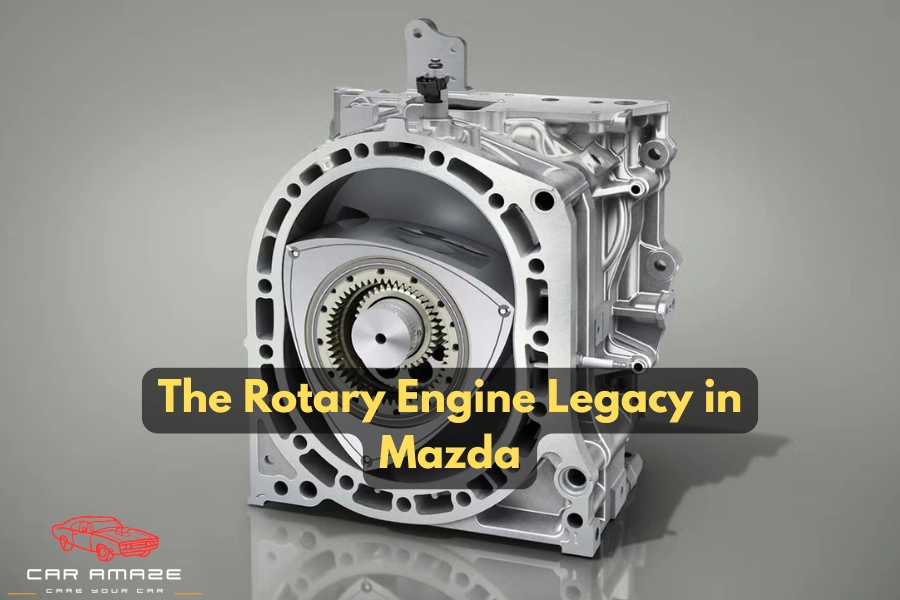
Mazda is the only automaker in the world that has commercially mass-produced cars with a Wankel rotary engine. The rotary debuted in the 1967 Cosmo Sport and powered the legendary RX-7 and RX-8 models. After a hiatus, Mazda brought it back in 2023, not as a primary engine, but as a range-extender generator in the MX-30 R-EV hybrid.
Electrification Plans
Mazda says 100% of its products will be electrified by 2030, with all-electric vehicles accounting for at least 25% of the lineup. Current electrified offerings include the CX-90 PHEV and the MX-30 R-EV. A new battery electric crossover is planned from Mazda’s updated Hiroshima plant in 2026.
Is Mazda a Reliable Car Brand?
The ownership question and the reliability question are closely connected for buyers, knowing who makes a car tells you a lot about the standards behind it.
In J.D. Power’s 2025 U.S. Vehicle Dependability Study, Mazda ranked second in the mass market segment with a score of 161 problems per 100 vehicles (PP100). That score places Mazda ahead of Toyota, Honda, and most of the mainstream competition.
Consumer Reports rated 32 car brands in 2025 and ranked Mazda as the 6th most reliable brand to purchase new and the 3rd most reliable brand to buy used. For used car buyers specifically, that third-place finish is significant, it means Mazda vehicles hold up well beyond their initial ownership period.
Mazda cars also carry among the lowest average repair costs in the industry, one repair shop analysis placed average Mazda repair costs at $457.46, the lowest of any brand measured.
For buyers comparing Mazda against other brands on reliability, our guide on are Buicks good cars covers how another traditionally reliable mainstream brand stacks up across similar metrics.
Final Thoughts
Mazda is Japanese-made, Japanese-owned, and independently operated. Ford’s ownership chapter closed in 2015. Toyota’s 5.1% stake funds a manufacturing partnership, not a takeover. And the cars themselves, built primarily in Hiroshima with growing production in Alabama and Mexico, carry the engineering standards of a company that has spent over a century building vehicles in the same city where it was founded.
For buyers, that background matters. An independent automaker answers to its customers and its shareholders, not to a parent company’s global platform strategy. Mazda’s reliability rankings reflect exactly that kind of focused, undiluted engineering commitment.
FAQs
Who makes Mazda cars?
Mazda Motor Corporation, an independent Japanese automaker founded in 1920 and headquartered in Hiroshima, Japan. The company is publicly traded and operates independently of Ford, Toyota, and every other automaker.
Who owns Mazda?
Mazda Motor Corporation owns itself as a publicly traded company. Toyota holds a 5.1% minority stake from their 2017 manufacturing alliance. No single company has controlling ownership of Mazda.
Does Ford own Mazda?
No. Ford sold its final Mazda shares in 2015. At its peak in 1996, Ford held a 33.4% stake. That relationship ended completely a decade ago and no operational or ownership ties remain.
Does Toyota own Mazda?
No. Toyota holds a 5.1% stake as part of a 2017 strategic alliance, primarily to support their joint Alabama manufacturing plant. Toyota has no authority over Mazda’s products or brand direction.
Where is Mazda made?
Primarily in Japan, at plants in Hiroshima and Yamaguchi Prefecture. Additional manufacturing occurs in the USA (Alabama), Mexico (Salamanca), China, and Thailand depending on the model and target market.
Where is the Mazda CX-5 made?
The CX-5 is primarily built at Mazda’s Ujina Plant in Hiroshima, Japan. North American buyers typically receive Japan-built units. Check the first character of your VIN — “J” confirms Japanese origin.
Who makes the Mazda 3?
The Mazda3 is built at Mazda’s Ujina Plant in Hiroshima, Japan, and at the Salamanca plant in Mexico. North American buyers may receive either depending on trim and model year.
What country is Mazda from?
Japan. Mazda has been a Japanese company since its founding in Hiroshima on January 30, 1920, and remains Japanese-owned and Japanese-headquartered today.c instructions.