Distilled Water in Car Coolant: What You Should Know

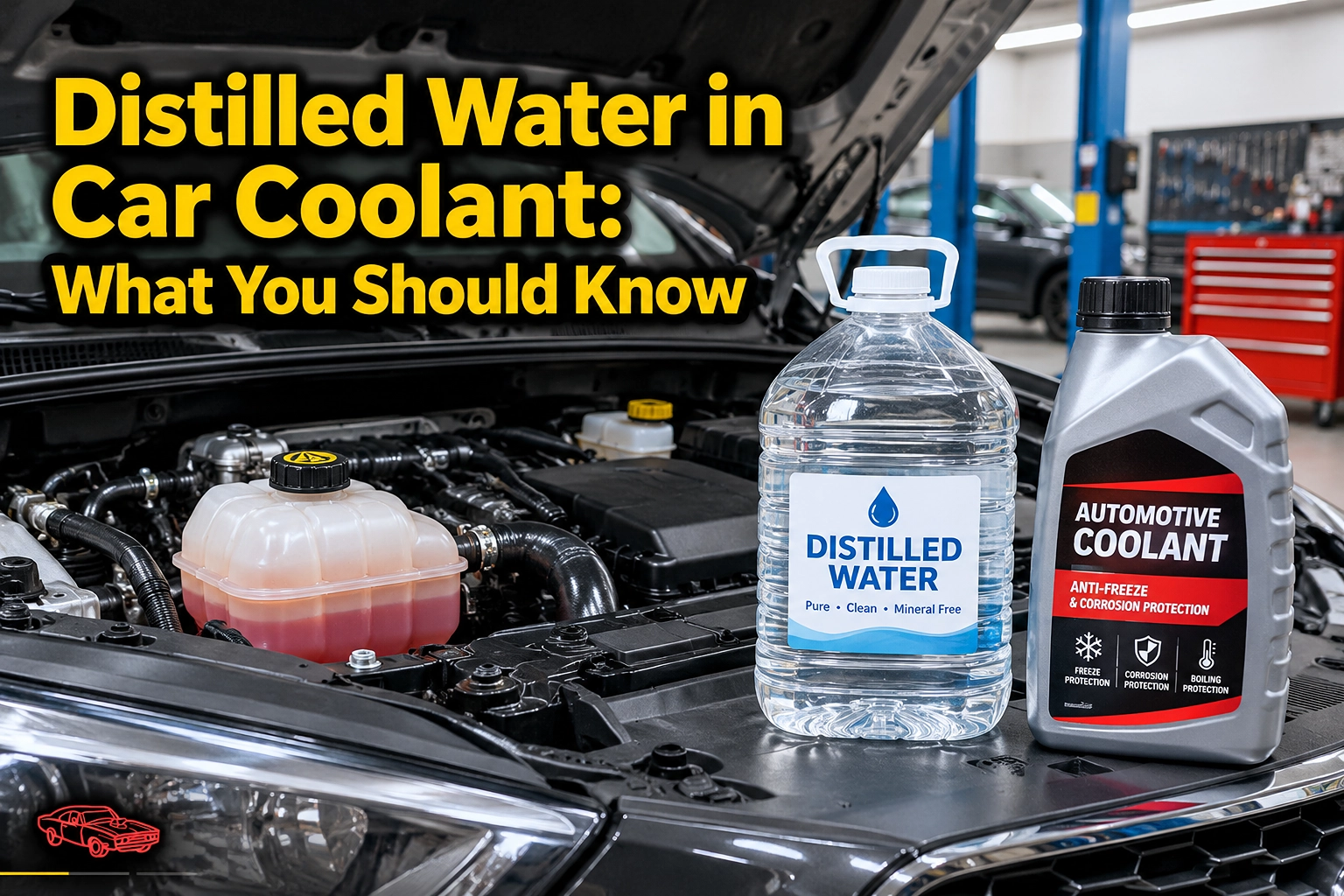
If you’re wondering whether you can use distilled water in car coolant, the answer is yes—but only when it is used correctly. Distilled water is commonly used to dilute concentrated coolant because it contains very few minerals that can leave deposits in the cooling system. However, distilled water alone does not provide the freeze, corrosion, and boiling protection your engine needs. The right coolant type and mixture depend on your vehicle and climate.
Table of contents
- Can You Use Distilled Water in Car Coolant?
- Why Is Distilled Water Used With Car Coolant?
- Distilled Water vs. Tap Water in a Car Cooling System
- Can You Use 100% Distilled Water as Car Coolant?
- How Much Distilled Water Should You Mix With Coolant?
- Coolant vs. Distilled Water for a Car in the North
- Does Distilled Water Freeze in a Car?
- What Is Better: Distilled Water, Deionized Water, or Bottled Water?
- Premixed Coolant vs. Coolant Concentrate
- How to Add Distilled Water to Car Coolant
- What Happens If You Accidentally Put Tap Water in Coolant?
- Common Mistakes When Using Distilled Water in Car Coolant
- How to Know if Your Coolant Mixture Needs Attention
- Should You Use Distilled Water in Your Radiator?
- What Is Better in Cold Weather: Coolant or Distilled Water?
- Final Takeaway
- Conclusion
- FAQs
Can You Use Distilled Water in Car Coolant?
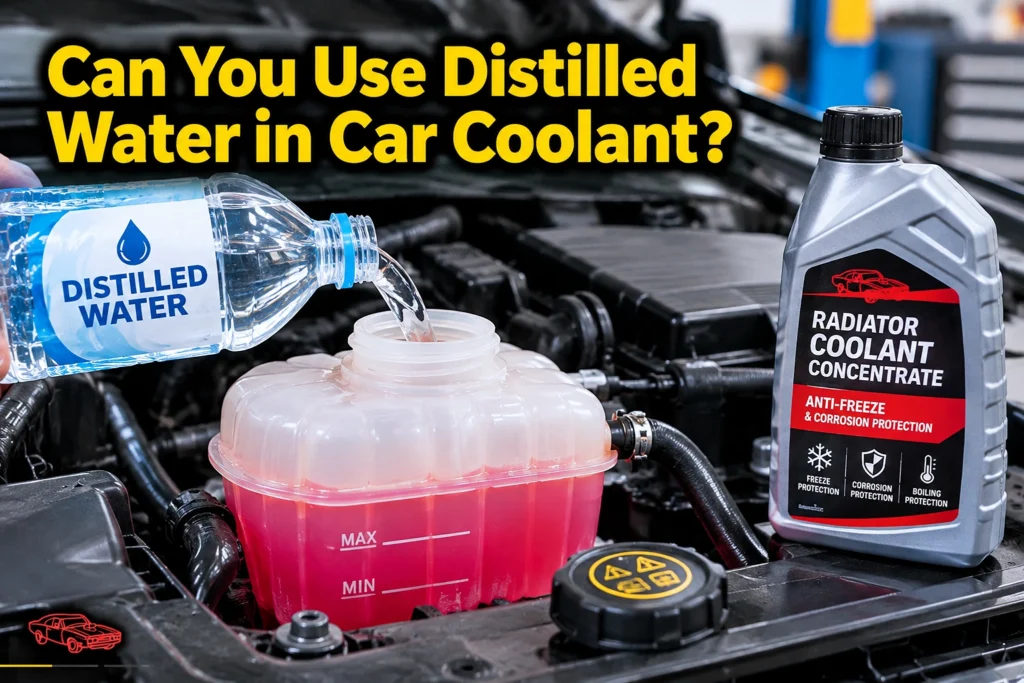
Yes, distilled water can be used with automotive coolant, and it is often preferred over ordinary tap water when a manufacturer calls for water to be mixed with concentrated coolant.
The important distinction is that distilled water is not the same thing as coolant. Distilled water provides the water portion of the mixture, while antifreeze/coolant contains chemicals that help protect the cooling system from freezing, corrosion, deposits, and excessive temperatures.
For example, Toyota specifies coolant that is already mixed with deionized water in some vehicles. Its 2026 Tacoma manual lists Toyota Super Long Life Coolant as a 50/50 coolant and deionized-water mixture in the U.S. Kia likewise specifies distilled, deionized, or soft water for certain coolant applications and warns against using hard water.
So, if you’re using concentrated coolant, distilled or deionized water may be the correct water component. If you’re using a premixed or 50/50 coolant, however, you generally should not add an equal amount of distilled water just because the bottle says coolant. Doing that changes the concentration. Always check the coolant label and your owner’s manual before mixing anything.
Why Is Distilled Water Used With Car Coolant?
The main reason is simple: water quality matters inside the cooling system.
Tap water isn’t chemically identical everywhere. It can contain minerals such as calcium and magnesium, along with other dissolved substances. Depending on the water source, those minerals can contribute to deposits inside the cooling system.
Distilled water has had most dissolved minerals removed through distillation. That makes it a useful choice when you need to dilute concentrated coolant.
Distilled water has fewer dissolved minerals
A vehicle’s cooling system contains narrow passages through the engine, radiator, heater core, and other components. Mineral-heavy water can leave deposits over time. Keeping unnecessary minerals out of the system helps reduce this concern. This is one reason manufacturers may specify distilled, deionized, or soft water instead of hard water.
Distilled water helps create the intended coolant mixture
Coolant concentrate is designed to be diluted according to the manufacturer’s instructions. When the correct amount of distilled or deionized water is added, the resulting mixture can provide the intended balance between coolant and water. That balance affects freezing protection, heat transfer, corrosion protection, and boiling characteristics.
Distilled water does not provide the protection of coolant
This is where many people get confused. Distilled water is useful as part of the coolant mixture, but it does not contain the additives found in automotive antifreeze/coolant. A proper coolant system needs more than water.
Distilled Water vs. Tap Water in a Car Cooling System
If you have both options available and your coolant requires water for dilution, distilled or deionized water is generally the safer choice than hard tap water.
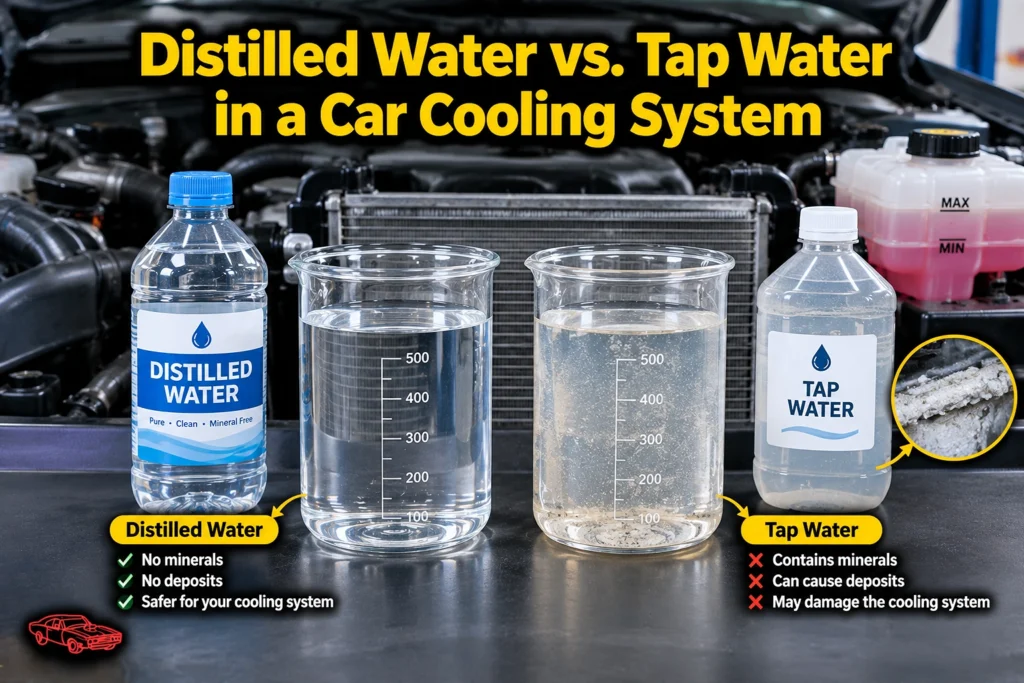
Here’s the basic difference:
| Feature | Distilled Water | Tap Water |
| Dissolved minerals | Very low | Varies by location |
| Mineral deposit concern | Lower | Can be higher |
| Suitable for mixing coolant | Commonly used when specified | Usually not preferred for long-term mixing |
| Freeze protection by itself | No | No |
| Corrosion protection by itself | No | No |
| Best use | Diluting compatible coolant concentrate | Emergency use only when appropriate, followed by proper service |
This does not mean one accidental top-up with tap water will automatically destroy your engine. Water quality varies, and a small emergency addition is very different from running an incorrect water-heavy mixture for months or years.
The bigger concern is repeatedly using hard water or ignoring the specified coolant mixture. Kia’s current owner documentation specifically says to use deionized or soft water and not mix hard water into the factory coolant on applicable vehicles.
Can You Use 100% Distilled Water as Car Coolant?
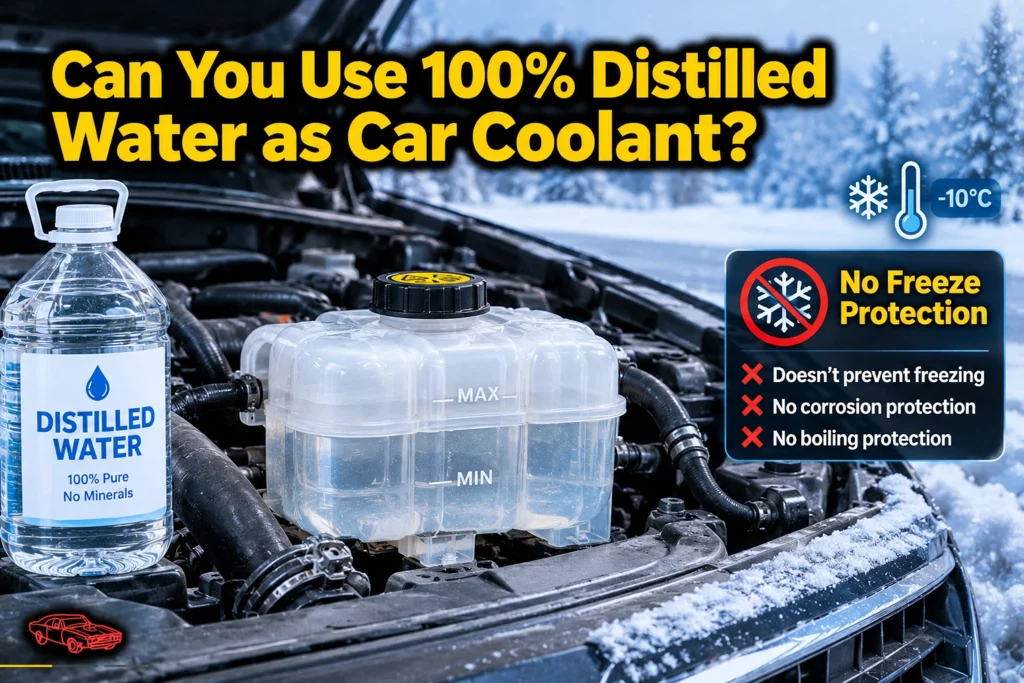
You can physically put distilled water into a cooling system, but 100% distilled water is not normally an appropriate long-term replacement for automotive coolant.
Water is actually very good at transferring heat, which is why it is such an important part of many cooling-system mixtures. The problem is that an engine cooling system needs additional protection. A properly formulated coolant helps protect against:
- Freezing
- Corrosion
- Deposits
- Boiling and excessive temperatures
- Damage to cooling-system components
Straight distilled water does not provide the same package of protection.
What happens if you run only distilled water?
The most obvious problem in cold weather is freezing. Water freezes at about 32°F (0°C). When water freezes, it expands. If that happens inside parts of a cooling system, the resulting pressure can cause serious damage.
There is another issue: distilled water is not a substitute for the corrosion-inhibiting additives in automotive coolant. So although distilled water can be part of the solution, it shouldn’t normally be considered the solution by itself.
Is distilled water useful in an emergency?
It can be useful when you need to prevent a low-coolant condition from leaving the engine without enough fluid, but the situation matters. If your coolant level is dangerously low and you have no suitable coolant available, getting the vehicle safely serviced is more important than pretending a temporary water top-up is a permanent repair.
Once the immediate problem is handled, the coolant concentration should be checked and corrected if necessary. If you repeatedly need to add water, don’t keep topping it off indefinitely. A cooling system that keeps losing coolant may have a leak or another problem that needs attention.
How Much Distilled Water Should You Mix With Coolant?
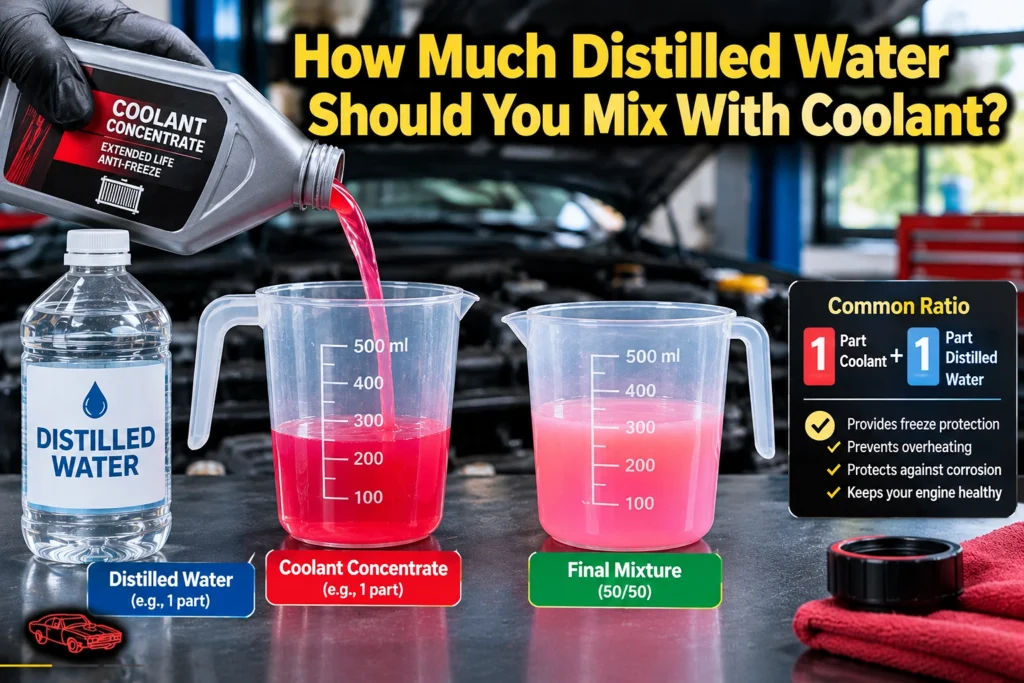
There is no single coolant-to-water ratio that is correct for every vehicle. 50/50 is common, but don’t assume 50/50 is automatically correct for your car. The correct ratio depends on the coolant product, vehicle manufacturer, and required temperature protection.
Is a 50/50 coolant and distilled water mixture common?
Yes. Many automotive coolants are designed to work as a roughly 50/50 mixture of antifreeze and water when starting with concentrated coolant. But some manufacturers specify different concentrations.
For example, Toyota’s 2026 Tacoma documentation says its specified Super Long Life Coolant is already premixed with 50% coolant and 50% deionized water in the U.S. and 55% coolant and 45% deionized water in Canada.
That is an important reminder that you shouldn’t automatically change the mixture based on a generic internet recommendation.
What if your coolant is concentrated?
If the bottle contains concentrated coolant, the label will normally specify how to dilute it. For a product intended to be mixed 50/50, you would generally combine equal parts concentrate and the specified water. For example:
- 1 gallon coolant concentrate + 1 gallon distilled water = 2 gallons of a 50/50 mixture.
- 1 liter coolant concentrate + 1 liter distilled water = 2 liters of a 50/50 mixture.
But always use the product’s instructions rather than assuming every coolant concentrate has the same requirements. Prestone, for example, instructs users of its concentrate to combine it with distilled water to achieve the freeze and boil-over protection specified on the product.
What if the coolant is already premixed?
This is where you need to be careful. If the container says:
- 50/50
- Prediluted
- Ready to use
- Premixed
it generally already contains the required water.
Adding more distilled water changes the concentration. For example, if your car requires a 50/50 premixed coolant and you add a large amount of distilled water, you have diluted the coolant below its intended concentration.
Coolant vs. Distilled Water for a Car in the North
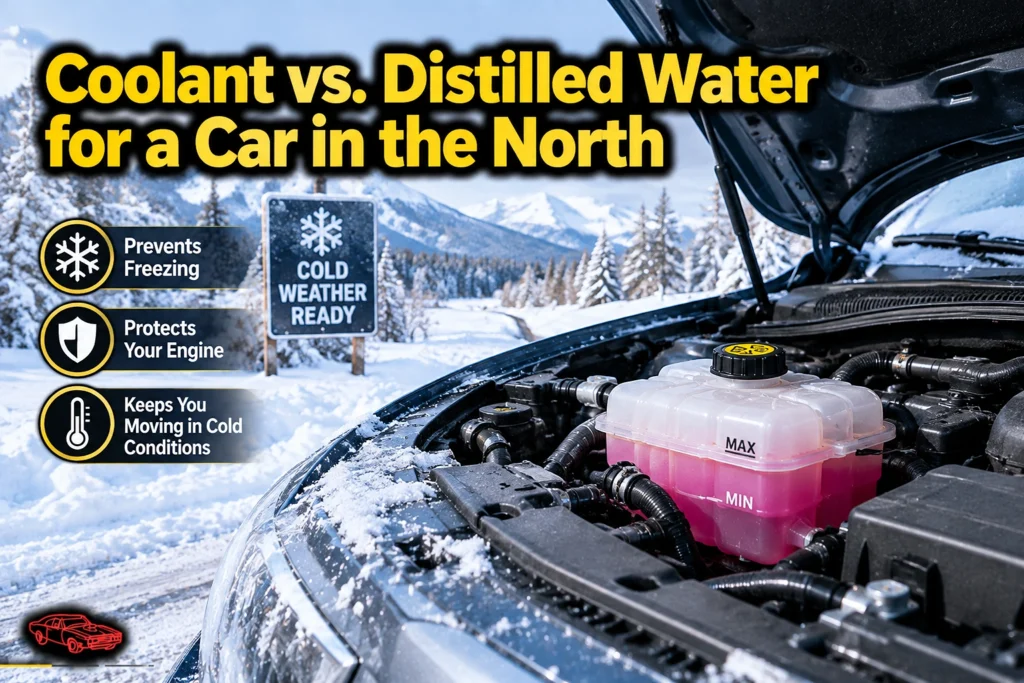
When comparing coolant vs distilled water for a car in the north, temperature is one of the biggest factors to consider. The colder the climate gets, the more important the coolant mixture’s freeze protection becomes.
Distilled water by itself can freeze. Properly formulated antifreeze lowers the freezing point of the mixture and helps protect the cooling system in cold conditions. But there’s an important detail that is often missed:
More antifreeze isn’t always better. You need the concentration specified for the vehicle and the expected temperature.
Kia’s current owner documentation provides an example of how the required mixture can change with ambient temperature. One current Kia manual lists 35% antifreeze/65% water at -15°C, 40/60 at -25°C, 50/50 at -35°C, and 60/40 at -45°C. It also warns against using a solution containing more than 60% or less than 35% antifreeze for that application.
Those figures are not a universal recipe for every car. They demonstrate why the manufacturer’s specifications matter.
What happens if there is too much water in the coolant?
In a cold climate, too much water can reduce freeze protection. If the mixture freezes, expanding ice can damage components of the cooling system. A weak coolant mixture can also leave the system without the corrosion protection intended by the manufacturer.
This is particularly important if you live in a region with very cold winters or plan to drive into a significantly colder climate.
What happens if there is too much antifreeze?
Adding more antifreeze isn’t a shortcut to maximum protection. Coolant is formulated to work at particular concentrations. Going outside the manufacturer’s specified range can reduce the effectiveness of the mixture.
That’s why you should not simply pour concentrated antifreeze into a cooling system until you think it is “strong enough.” If you’re unsure about the existing mixture, a repair shop can test its freeze protection and determine whether the coolant needs correction.
Does Distilled Water Freeze in a Car?
Yes. Distilled water is still water, so it can freeze at approximately 32°F (0°C) under normal conditions. Distillation removes minerals and other impurities; it does not turn water into antifreeze.
This distinction is important for anyone driving in a cold northern climate. If your cooling system contains mostly distilled water, the water can freeze when temperatures drop below its freezing point.
A properly formulated coolant mixture is designed to provide much greater freeze protection. That’s why distilled water and antifreeze have different jobs in a cooling system.
What Is Better: Distilled Water, Deionized Water, or Bottled Water?
These terms are sometimes used interchangeably in casual automotive conversations, but they aren’t identical.
Distilled water
Distillation uses a process involving evaporation and condensation to remove many dissolved substances. It is commonly available in stores and is often used for mixing coolant when the manufacturer or coolant product calls for it.
Deionized water
Deionized water has had ions removed through a different treatment process. Automotive manufacturers may specifically call for deionized water rather than distilled water. For example, Toyota describes some of its factory coolant as being premixed with deionized water.
Soft water
Some manufacturers allow soft water. Kia’s current manuals, for applicable vehicles, specify distilled, deionized, or soft water and warn against hard water.
Bottled drinking water
Don’t assume bottled drinking water is the same as distilled water. Minerals may still be present in drinking water because the water is intended for consumption, not necessarily for use in a vehicle cooling system.
If your coolant instructions call for distilled or deionized water, buy that type rather than substituting ordinary bottled drinking water.
Filtered water
A household filter does not automatically produce water equivalent to distilled or deionized water. Different filtration systems remove different substances. For coolant mixing, follow the vehicle or coolant manufacturer’s water specification.
Premixed Coolant vs. Coolant Concentrate
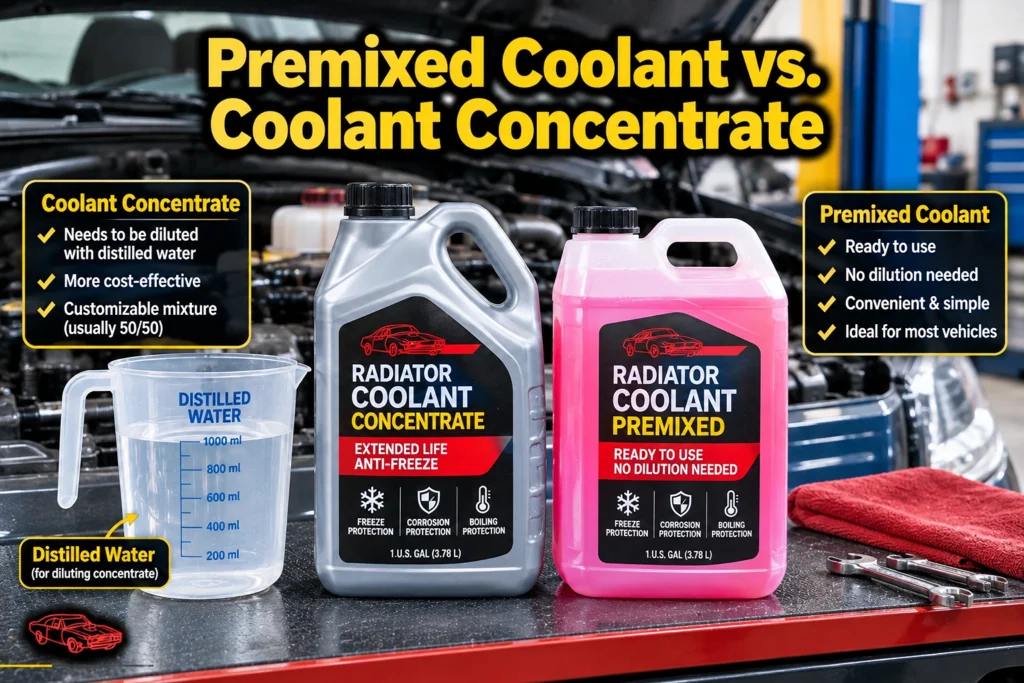
Understanding this difference can prevent one of the most common coolant mistakes.
| Coolant type | Add distilled water? | What to do |
| Concentrated coolant | Usually yes | Follow the bottle’s specified ratio |
| 50/50 premixed coolant | Usually no | Use as supplied |
| Ready-to-use coolant | Usually no | Follow product instructions |
| Vehicle-specific factory premix | Usually no | Follow the owner’s manual |
| Distilled water alone | Not a normal replacement | Does not provide full coolant protection |
If you buy concentrate, you are expected to create the final mixture. If you buy a premixed coolant, someone has already done that job for you.
For example, Toyota specifies factory coolant that is already premixed on applicable models, while Prestone gives separate instructions for concentrate and 50/50 prediluted products. Always read the front and back of the container before adding anything.
How to Add Distilled Water to Car Coolant
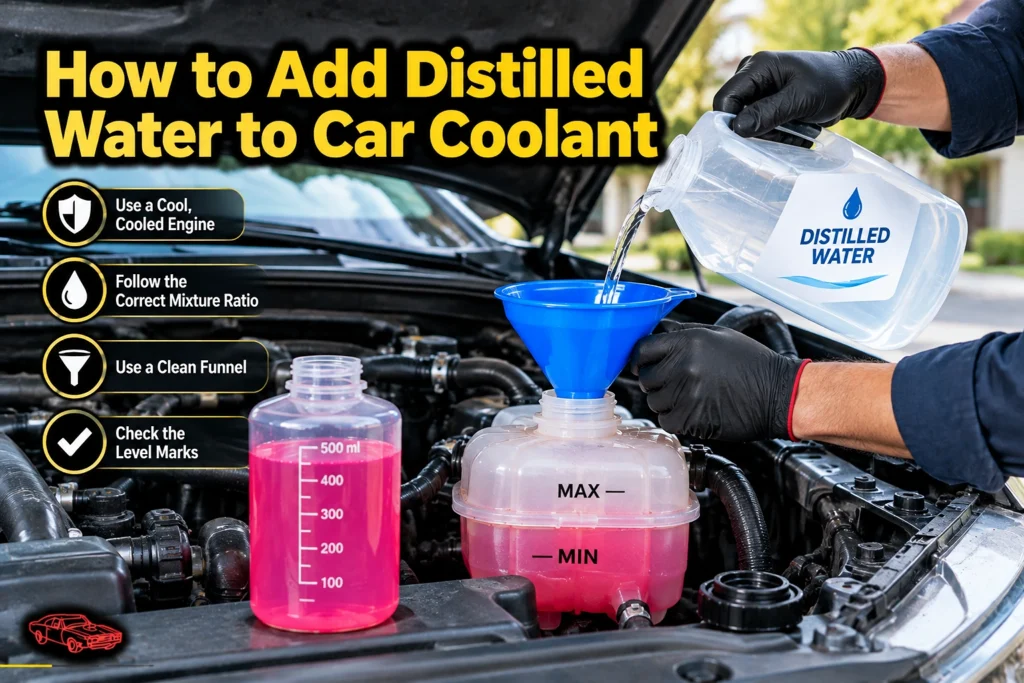
If your vehicle uses coolant concentrate that needs dilution, the basic process is straightforward.
1. Let the engine cool
Never open a hot radiator or pressurized coolant reservoir simply because the coolant level looks low. Hot coolant can be under pressure and cause severe burns. Kia specifically warns against removing the coolant or radiator cap when the engine and radiator are hot. Safety precautions are necessary to avoid problems like car shudders when idle.
2. Check the owner’s manual
Before mixing anything, confirm:
- Correct coolant specification
- Required coolant type
- Whether the vehicle uses premixed coolant
- Required coolant concentration
- Where the coolant reservoir is located
3. Identify the coolant you have
Check whether you’re holding:
- Concentrate
- 50/50 premix
- Ready-to-use coolant
This one step can prevent an incorrect mixture.
4. Use the specified water
If the instructions call for distilled or deionized water, use it. Avoid assuming ordinary tap water is an equivalent substitute, especially if you have hard water.
5. Mix according to the specified ratio
If your coolant calls for a 50/50 mixture, combine equal parts concentrate and distilled water. If the manufacturer specifies another ratio, follow that instead.
6. Fill to the correct level
If you’re filling the expansion reservoir, use the appropriate MIN/MAX or LOW/FULL markings. Don’t overfill.
7. Recheck the level
Once the engine has cooled again, check the reservoir level. If the level keeps dropping, the issue may not be the amount of water you added. A leak or another cooling-system problem may need to be diagnosed. For more information on checking fluid levels, see our guide on how to check car fluids.
What Happens If You Accidentally Put Tap Water in Coolant?
Don’t panic if you accidentally add a small amount of tap water. The severity depends on:
- How much water was added
- The mineral content of the water
- The existing coolant concentration
- How long the vehicle has been operated with that mixture
- The vehicle manufacturer’s requirements
A small emergency top-up is different from repeatedly filling the cooling system with hard tap water.
If you added a small amount
If the coolant level was low and you added a modest amount of tap water to get the car safely home, it doesn’t automatically mean the cooling system is ruined. However, check the coolant concentration when practical.
If you’ve been using tap water repeatedly
That’s a different situation. Repeated use can introduce minerals into the cooling system and may alter the intended coolant concentration.
If you’ve routinely used tap water, consider having the cooling system inspected and the coolant concentration checked.
If the car is overheating
Don’t assume changing the water will solve it. Overheating can have many causes, including:
- Low coolant
- Coolant leaks
- Failed thermostat
- Cooling fan problems
- Water pump problems
- Radiator problems
- Head-gasket issues
- Blocked cooling passages
If your vehicle is overheating, stop driving when it is safe to do so and diagnose the actual problem.
Our guide to car overheating when idle can help if the overheating mainly occurs while the vehicle is sitting still.
Common Mistakes When Using Distilled Water in Car Coolant
Using distilled water correctly is simple, but several mistakes are common.
1. Using 100% distilled water permanently
Distilled water does not provide the complete protection of automotive coolant.
2. Adding water to premixed coolant
If the coolant is already 50/50, adding more water dilutes the formula.
3. Assuming every car uses a 50/50 mixture
50/50 is common, but manufacturer specifications vary.
4. Using hard tap water repeatedly
Hard water can contain minerals that are undesirable in a cooling system.
5. Choosing coolant based only on color
Coolant color alone isn’t a reliable way to determine compatibility.
Always check the product specification vehicle requirements.
6. Mixing incompatible coolants
Different coolant technologies may not be interchangeable.
If you’re unsure what is already in the system, don’t choose a new coolant simply because its color looks similar.
7. Adding more antifreeze because the weather is cold
A stronger mixture isn’t automatically better.
Use the concentration specified for the vehicle and expected temperatures.
8. Opening the radiator cap while the engine is hot
This can release pressurized coolant and steam.
Wait until the system has cooled.
9. Continuing to add water without investigating coolant loss
If the level keeps dropping, find out why.
A cooling system shouldn’t require constant top-ups under normal conditions.
10. Ignoring the owner’s manual
The owner’s manual is more useful than a generic 50/50 rule because it tells you what your specific vehicle requires.
How to Know if Your Coolant Mixture Needs Attention
The coolant level and coolant mixture are two different things. You can have enough coolant in the reservoir but still have the wrong concentration. Likewise, you can have the correct concentration but an insufficient coolant level. Watch for these signs:
- Coolant level repeatedly falls
- Engine temperature rises
- Temperature warning light appears
- Coolant leaks underneath the vehicle
- Sweet coolant smell
- Visible residue around hoses or connections
- Coolant looks contaminated
- Vehicle overheats
- Heater performance changes unexpectedly i.e. car heater blowing cold air.
- Cooling-system freeze protection is inadequate
If you repeatedly need to refill the reservoir, don’t simply keep adding distilled water. Kia’s current owner documentation specifically recommends having the system inspected when frequent coolant refills are required.
If you’re checking several fluids during routine maintenance, our guide on how to check car fluids is a useful place to start.
Should You Use Distilled Water in Your Radiator?
If your vehicle’s coolant system calls for water to be mixed with concentrated coolant, distilled or deionized water is generally an appropriate choice. But don’t treat the radiator as a container that should simply be filled with distilled water.
The cooling system needs the correct coolant mixture. If your car uses a premixed coolant, use it according to the manufacturer’s instructions rather than diluting it unnecessarily. If you aren’t sure what is currently in the system, check the owner’s manual or have the coolant identified and tested.
What Is Better in Cold Weather: Coolant or Distilled Water?
For cold-weather protection, the important point is that coolant and distilled water perform different jobs. Distilled water is useful as the water component of an appropriate coolant mixture. Coolant supplies antifreeze and corrosion-inhibiting properties that plain water doesn’t provide.
| Situation | Distilled water alone | Correct coolant mixture |
| Heat transfer | Good | Good |
| Freeze protection | Poor | Designed for specified temperatures |
| Corrosion protection | Limited | Contains protective additives |
| Long-term cooling-system use | Not normally suitable | Designed for this purpose |
| Cold northern climate | Inadequate by itself | Appropriate when correctly specified |
For a vehicle operating in a very cold climate, check the coolant’s actual freeze protection rather than guessing based on how much antifreeze you added.
Kia’s published specifications demonstrate that coolant concentration can be adjusted according to ambient temperature, but the exact requirements are vehicle-specific.
Final Takeaway
Using distilled water in car coolant is a good practice when you’re diluting a compatible concentrated coolant and the manufacturer calls for distilled or deionized water. Its low mineral content makes it preferable to many sources of hard water for this purpose.
But distilled water is only one part of the cooling-system equation. Don’t replace coolant with straight distilled water for normal long-term driving. Don’t dilute a premixed coolant unnecessarily, and don’t assume that 50/50 is correct for every vehicle.
If you drive in a cold northern climate, pay particular attention to the coolant’s freeze protection. The correct concentration depends on the vehicle, coolant formulation, and expected temperature.
The safest approach is simple: use the specified coolant, use the specified water when dilution is required, and follow the mixture ratio in your owner’s manual or coolant manufacturer’s instructions.
FAQs
Is distilled water good for car coolant?
Yes. Distilled water is commonly used as the water component when diluting concentrated automotive coolant, provided the vehicle and coolant manufacturer permit or specify it. It should not normally replace coolant by itself.
Can I use distilled water instead of coolant?
Not as a normal long-term replacement. Distilled water lacks the antifreeze and corrosion-inhibiting additives found in automotive coolant.
Can I mix distilled water with antifreeze?
Yes, when using a concentrated coolant that is designed to be diluted with water. Follow the mixture ratio specified by the coolant and vehicle manufacturer.
Is 50/50 coolant and distilled water always correct?
No. A 50/50 mixture is common, but it isn’t universal. Some vehicles and climates call for different concentrations.
Is distilled water better than tap water for a radiator?
When water is required for coolant mixing, distilled or deionized water is generally preferable to hard water because it contains far fewer dissolved minerals.
Can distilled water freeze in a car?
Yes. Distilled water is still water and can freeze at around 32°F (0°C). It does not provide the freeze protection of antifreeze/coolant.
What happens if I use only distilled water in my radiator?
The cooling system loses the protection supplied by antifreeze additives, and the water can freeze in cold conditions. It isn’t normally suitable as a permanent coolant replacement.
Should I add distilled water to premixed coolant?
Usually no. Premixed coolant already contains water at the intended concentration. Adding more water can dilute it.
Is bottled water OK for car coolant?
Don’t assume ordinary bottled drinking water is equivalent to distilled or deionized water. Follow the water specification for your vehicle and coolant.
What coolant mixture is best for cold climates?
The correct mixture is the one specified by the vehicle and coolant manufacturer for the expected temperatures. Do not automatically increase the antifreeze concentration beyond the recommended range.